
Sdílej článek:
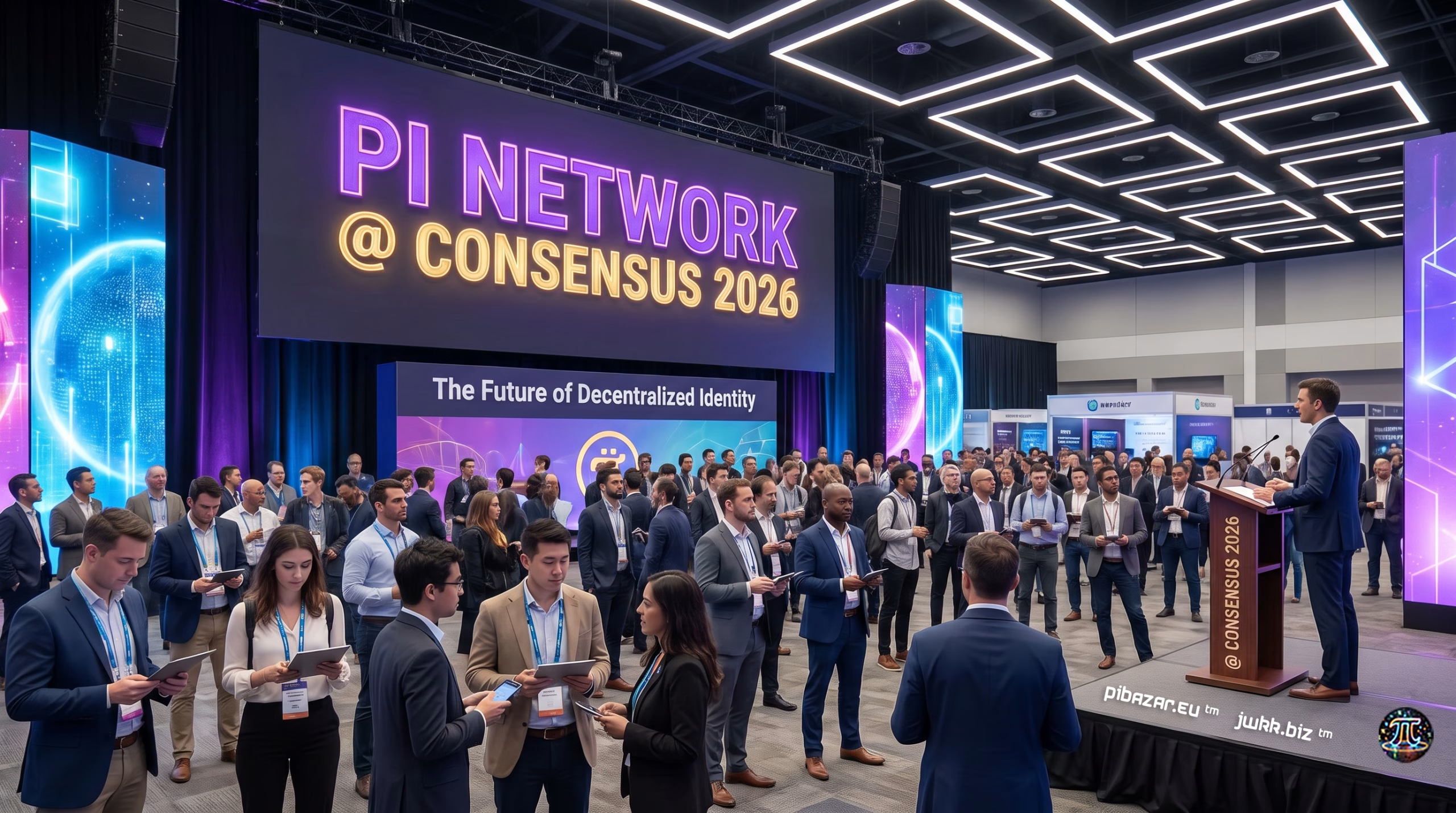
This article details the participation of the founders of Pi Network at the Consensus 2026 conference, where they presented a vision of connecting blockchain, artificial intelligence and real-world usability.
Dr. Chengdiao Fan focused on creating utility cryptocurrencies and criticized their use for speculative purposes only. Dr. Nicolas Kokkalis then discussed the necessity of human authentication in a digital world increasingly flooded with automated bots. Together, they emphasized that the Pi Network infrastructure is intended to serve as a secure foundation for sustainable business models and trusted interactions. The overall goal of the project is to ensure that technological advances in AI support real users, rather than artificially generated activity. These resources offer a comprehensive look at Pi Network’s efforts to integrate digital identity with practical use in the modern technology ecosystem.
Contents article 📖
Estimated reading time: 14 minut
- Podcasts
- Infographics
- Pi Network at Consensus 2026 Conference: Building Useful Value and Trust in the Era of AI
- The Future of Web3 Captured by AI:
- Conclusion: The Real Challenge of Digital Transformation
- Share the article 🙏
- Related articles …
- Pi Network
Podcasts 🎙️ Infographics 🖼️
Podcasts
Explanation [Video]
A structured, comprehensive overview that links the individual pieces of information from the article in English.
Detailed Analysis [Audio]
Live conversation between two moderators, breaking down and linking topics from the article in English.
Infographics
Pi Network at the Consensus 2026 conference – Web3 Utility and AI Verification
![Pi Network at the Consensus 2026 conference - Web3 Utility and AI Verification [Infographics]](https://pibazar.eu/wp-content/uploads/2026/08/pi-network-at-the-consensus-2026-conference-web3-utility-and-ai-verification-scaled-png.avif "Pi Network at the Consensus 2026 conference - Web3 Utility and AI Verification")
Lectures by Pi Network founders at the Consensus 2026 conference 🎦
| Speakers | Section name | Lecture topic | Keynotes technology | Key challenges and solutions | Implication for users | Source |
|---|---|---|---|---|---|---|
| Dr. Nicolas Kokkalis | How to Prove You’re Human in an AI World (Without Doxing Yourself) | Proving Humanity in the AI Era and Privacy | Identity verification (KYC), Layer 1 blockchain, non-custodial wallets, smart contracts, payment infrastructure | The risk of AI-generated bots and fake profiles; the solution is contextual proof of humanity and privacy-preserving verification without excessive sharing of personal data. | Ensuring trusted participation in the digital space and protecting privacy in identity verification. | [1] |
| Dr. Chengdiao Fan | Aligning Web3, AI, and Blockchain for Utility | Aligning Web3, AI, and Blockchain for Utility; Sustainable Business Models | Pi Launchpad, Blockchain Infrastructure, Identity Verification, Ecosystem Tokens | The Mismatch Between Token Design and Product Innovation; the solution is to use tokens as tools for user acquisition and long-term benefit instead of just raising capital. | Approach to real-benefit products where users can provide feedback and use tokens in real-world applications. | [1] |
[1] Consensus 2026 Talks | Pi Network
Pi Network at Consensus 2026 Conference: Building Useful Value and Trust in the Era of AI
1. Brief Summary (Key Knowledge)
The speech by the founders of Pi Network at the Consensus 2026 conference in Miami defined a critical paradox of current technological developments: while artificial intelligence (AI) drastically lowers the barriers to the creation of digital content and applications, it proportionately increases the value of „verified humanity.“ Dr. Chengdiao Fan and Dr. Nicolas Kokkalis presented a vision in which blockchain serves not only as a financial layer, but as an essential infrastructure for distributing trust and real utility value in an ecosystem where it is increasingly difficult to distinguish authentic human activity from automated systems.
Key points:
- The utility over speculation paradigm: Transforming the role of tokens from tools for speculative capital raising to strategic mechanisms for user acquisition and long-term building products.
- Context-dependent proof of humanity: Implementing identity verification that adapts to the context – from confirming a unique human actor to full identity verification where necessary.
- Privacy protection and elimination of “doxing”: The requirement for verification systems that minimize the exposure of sensitive personal data while maintaining high user-friendliness.
- Agent economy: The strategic need to distinguish between legitimate AI agents representing humans and fraudulent activity imitating human behavior.
2. Coordination of Web3, AI and blockchain for real utility
Dr. Chengdiao Fan identified a structural problem in the cryptocurrency industry in her analysis, which is the deep mismatch between token design and actual product innovation.
Analysis of the mismatch in the crypto industry:
- Tokens as a goal, not a tool: Historically, tokens have been abused primarily for quick capital raising and exit strategies, which has sidelined the development of functional products college.
- Financial engineering vs. product experience: The lack of focus on real user needs has led to ecosystems that lack sustainable value outside of speculative cycles.
A new approach to tokenization via Pi Launchpad:
Dr. Fan introduced Pi Launchpad as a model implementation of a new strategy where tokens are integrated directly into the product cycle. The goal is not just transactional activity, but creating a closed loop of engagement:
- Real user acquisition: Tokens serve as an incentive for real people to enter the ecosystem.
- Authentic feedback: By connecting to the Pi infrastructure, developers can obtain valuable data and feedback from a live community, which is a critical competitive advantage in the era of synthetic data generated by AI.
- Sustainable engagement: The token becomes an organic part of the user experience within functional applications, not just the subject of an exchange shop.
3. Identity verification in a digital world controlled by AI
During the panel discussion, Dr. Nicolas Kokkalis addressed the threat of devaluation of digital trust due to AI’s ability to generate convincing bots and fake profiles on a mass scale.
Contextual proof of humanity:
The analysis emphasizes that „proof of humanity“ is not a binary category. Dr. Kokkalis distinguishes between:
- Need for a specific identity: Situations that require precise knowledge of who is involved (e.g. in compliance with regulations).
- Need for a unique actor: Situations where it is sufficient to know that a unique person, not a bot, is behind the action, without revealing their full identity.
Privacy Protection Verification Principles:
According to Dr. Kokkalis must meet strict criteria:
- Anti-doxing: The system must protect user privacy and not require more data than is necessary for the given purpose.
- Global usability: The process must be intuitive and accessible to billions of people regardless of their technological proficiency.
The Future of the Agent Economy:
Dr. Kokkalis’s key technological insight is the need to support legitimate AI agents. The goal of verification systems is not to block automation across the board, but to be able to validate agents that represent and act on behalf of real people, and distinguish them from malicious software that pretends to be human for the purpose of manipulation.
4. Pi Ecosystem as a Solution to Future Challenges
Pi Network presents itself as a vertically integrated solution that combines a technology layer with a massive social base.
Technological and Community Pillars:
- Layer 1 blockchain: A robust base layer for transaction settlement.
- Identity verification (KYC): A proprietary system for scalable verification of humanity.
- Payment infrastructure and non-custodial wallets: Tools for direct control over assets and their easy integration into applications.
- Smart contracts: Logical layer for decentralized programming.
Scope of the network and its role in AI innovation:
With a community of over 60 million people, the Pi Network serves as a unique testbed for a new generation of applications. Connecting with concepts like Vibe Coding within Pi App Studio enables rapid development of applications using AI, but which are immediately confronted with real users. This human layer provides validation of usefulness and authentic interaction that AI alone cannot replicate.
5. Strategic Vision
The main conclusion of the founders‘ speech at Consensus 2026 is the realization that technological progress in the field of AI paradoxically brings to the fore the most important and at the same time the most difficult socio-technical challenge: connecting digital systems with real users and trustworthy human participation.
In this context, Pi Network does not appear just as another cryptocurrency project, but as a comprehensive infrastructure for the distribution of trust. A strategic focus on building real utility instead of speculation, supported by a robust KYC system and a community of sixty million, positions Pi as a key arbiter of humanity and utility in a digital space dominated by artificial intelligence.
The Future of Web3 Captured by AI:
Insights from Consensus 2026 that change the rules of the game
In 2026, we are witnessing an unprecedented digital paradox. While generative AI has dramatically lowered the barriers to content creation and streamlined digital interactions, it has also triggered a massive erosion of trust. We are facing a hyper-inflation of synthetic content, where it is almost impossible to distinguish between human intent and machine production. In this environment, authenticity becomes the most precious asset, and „digital proof-of-stake“ is virtually extinct in social discourse.
Just at this year’s prestigious Consensus conference in Miami, Pi Network founders Dr. Chengdiao Fan and Dr. Nicolas Kokkalis offered a way out of this crisis of trust. Their vision for 2026 is not about fighting technology, but about creating a strategic corrective. They presented Web3 not as a speculative casino, but as a necessary infrastructure for validating human nature and building real utility in a world dominated by algorithms.
The End of „tokenomics for Money“: Token as a Strategic Tool of Utility
Dr. In her presentation “Unifying Web3, AI and Blockchain for Utility,” Chengdiao Fan identified the main malady that has been holding back the crypto industry: a fatal mismatch between token design and real product innovation. For years, tokens have been seen as tools for speculative capital raising or quick exits, which in the era of AI, capable of generating thousands of empty projects per minute, leads to a complete devaluation of the market.
According to Dr. Fan, a radical shift to a “utility-first” approach must occur in 2026. The token must no longer be just a financial asset, but a strategic tool for acquiring real users and strengthening their engagement. A concrete example of this philosophy is Pi Launchpad. This mechanism allows products to acquire real users who actively interact with the applications and provide feedback, rather than relying on artificially generated transaction volume.
This approach is critical in the AI era. In an environment where bots can simulate activity on any platform, the only sustainable strategy is to tie the value of the token to real human interaction. If a project cannot generate value through a specific service that the algorithm cannot replace, it will not survive in the new digital order.
Proof of Humanity: How Not to Lose Your Identity in an Ocean of Bots
As AI systems have become capable of generating perfectly convincing digital imitations of humans, the question of identity verification has become an existential challenge. Dr. Nicolas Kokkalis, during a panel discussion on proving humanity, emphasized that “proof of humanity” cannot be a universal template, but must be contextual.
According to him, the key to survival in the digital space is privacy-preserving verification. In 2026, when biometric and personal data are the primary targets for AI-driven identity theft, the ability to confirm humanity without unnecessarily revealing sensitive data becomes a crucial competitive advantage and defensive necessity.
“The challenge posed by AI is not just technological sophistication, but above all our ability to reliably distinguish real people and their intentions from digital imitations that can simulate human behavior on a mass scale.”
Kokkalis also pointed out the need to distinguish between useful AI agents that act on behalf of people and fake bots that pretend to be human. However, for the mass adoption of these systems, “usability” (usability) is as important as security. If the process of proving identity is not intuitive for the average person, the digital space will remain a playground for sophisticated attackers and automated agents.
Infrastructure for a New Era: More Than Just Blockchain
To effectively address the challenges of AI, Web3 must offer more than just a decentralized database. Pi Network integrates technology layers that together form a barrier against digital noise:
- Layer 1 blockchain and payment infrastructure: A robust foundation for transparent value transfer that resists manipulation by AI.
- Smart Contracts: Programmable logic that, in 2026, will enable the automation of trust and the creation of complex ecosystems without the need for intermediaries.
- Know Your Customer (KYC) and Non-Custodial Wallets: A system that ensures the integrity of the network and gives users full sovereignty over their identity.
- Engaged community of over 60 million people: It is this range of verified human users that forms the greatest defense against AI bots. The true value of the network today does not come from code, but from proven human network effects.
Each of these elements serves as a filter that separates meaningful value from machine-generated spam in an automated world.
Conclusion: The Real Challenge of Digital Transformation
The message from the speech at Consensus 2026 is clear: AI has removed barriers to creation, but in doing so, it has disproportionately increased the price of truth. In this context, blockchain ceases to be the domain of financial speculators and becomes the basic infrastructure for preserving human authenticity.
The real challenge of digital transformation is no longer how to automate things more – AI can do that for us. The real challenge is how to identify and protect what is human in a fully automated world. In 2026, the most valuable thing you own is not your data, which AI has long analyzed, but your verified humanity.
Question to ponder: Given that the line between human and machine expression has virtually disappeared, how will you recognize true value in your digital future?
Share the article 🙏
Related articles …
Pi Network
Pi Network Announcement
Pi Network is a blockchain-based cryptocurrency project that aims to allow users to mine Pi coins using smartphones. The project aims to promote cryptocurrency adoption.
The project was launched by PhD students at Stanford University in 2019. Pi Network offers users a simple and environmentally friendly way to mine Pi coins by simply opening the app and pressing a button once a day.
One of the features of the Pi Network is that users can increase the mining speed by expanding their network. In addition, the Pi Network aims to increase the value of Pi coins by allowing users to create and use web applications on the Pi> platform.
Pi Network is currently launching its mainnet. To join Pi Network, you need to download the mobile app and enter an invitation code. Pi Network is an innovative project that aims to pave the way for the future of cryptocurrencies.
How to join Pi Network
If you are not a member of Pi Network, you can get started in 5 minutes by clicking this link. By registering with my referral code jwkkbiz we can both earn Pi. Pi Network is an application that allows you to easily mine the cryptocurrency „Pi“ on your smartphone. By pressing a button once a day, you start mining for 24 hours, even if you leave your phone idle. In 2024, I mined 360 days a year, and those who accepted the invitation received many benefits. If you register with the referral code jwkkbiz, you will get a 25% increase in mining speed.
After 30 mining, you will pass KYC (Know Your Credit), so don’t forget to enter your real name when registering. If you register incorrectly, you will lose 20% as a penalty.
For more detailed information and reasons for registration, see here.
Mohlo by se vám také líbit:
- Free shares worth up to €100 on Trading 212
- Aktualizace Podcastů – Rozdělení [CZ] a [EN] verzí
- Pi Network a „314 159 USD hodnota“: Největší hoax v historii projektu
- Kde externě sledovat, poslouchat a číst PiBazar.eu
- Pánské hodinky Montblanc Nicolas Rieussec Chronograph
- Pi Network jako zlatý sponzor TOKEN2049 v Singapuru
- OXVA Origin Mini Pod Kit (Eagle)
- Pi Day 2026 – Pi Network Milestones and News
- Web3 + Pi Network = 𝝿 (Pi)
Zanechat odpověď