
Sdílej článek:
This document contains technical documentation for the bip_utils library, which allows programmers to generate mnemonic phrases, private keys, and addresses for a wide range of cryptocurrencies, including Bitcoin and Cardano.
The next section discusses the importance of the ISO 20022 standard for the Pi Network project, highlighting how this standard facilitates the connection of digital assets with traditional banking systems and increases the efficiency of payments. The Pi Network‚s specific approach to energy-efficient mining via mobile phones is also mentioned. Finally, the article warns of the security risks associated with scams that target hardware wallet users via fake devices. Overall, the material combines deep technical instructions with information on payments standardization and digital asset protection.
Contents article 📖
Estimated reading time: 14 minut
- Podcasts
- Infographic
- Pi Network in 2026: Reality Revealed, Security Traps and Shocking Numbers
- Point No. 1: The Paradox of Decentralization – Who Really Holds the Keys holds the keys?
- Point No. 2: Price drop of 93% and the reality of tokenomics
- Point #3: Evolution of Fraud – When “fake hardware” comes in the mail
- Point #4: The Wallet Dilemma – Official Comfort vs. Cold Security
- Point No. 5: Technological Leap – Subscription Smart Contracts
- Analysis of the Pi Network Ecosystem and Asset Security Options (May 2026)
- View
- Conclusion: The Future at a Crossroads
- Share the article 🙏
- Related articles …
- Pi Network
Podcasts 🎙️ Infographics 🖼️
Podcasts
Explanation [Video]
A structured, comprehensive overview that links the individual pieces of information from the article.
Detailed Analysis [Audio]
Live conversation between two moderators, analyzing and connecting topics from the article.
Infographic
Global Financial Standard Transition Guide
![Global Financial Standard Transition Guide [Infographics]](https://pibazar.eu/wp-content/uploads/2026/09/global-financial-standard-transition-guide-infographics-2048x1143.png "Global Financial Standard Transition Guide [Infographics]")
Pi Network in 2026: Reality Revealed, Security Traps and Shocking Numbers
The Pi Network phenomenon has had a fascinating journey since its inception in 2019. From the promises of “mobile mining,” which many called a revolution and others a mere social experiment, we have finally arrived at the reality of the Open Mainnet, which launched on February 20, 2025. After years of waiting, the cards are finally on the table. For the 60 million registered “Pioneers”, however, the reality of 2026 is much different than they hoped for.
The goal of this analysis is to deconstruct the current state of the network, connect the technical facts about centralization with regulatory developments, and warn against the sophisticated methods used by attackers today to try to steal your lifetime earnings in PI.
Point No. 1: The Paradox of Decentralization – Who Really Holds the Keys holds the keys?
Pi Network is technically a Layer 1 blockchain built on a modified Stellar Consensus Protocol (SCP) that uses the Federated Byzantine Agreement (FBA) mechanism. Unlike Bitcoin, security here is not ensured by computing power, but by so-called „quorum slices“. These are individual sets of trusted nodes that users define within their security circles.
Despite the narrative of building the most decentralized network in the world, data from 2026 shows a fundamental paradox. Although the network reports millions of nodes, the technical core remains in the grip of the Core Team.
“All major mainnet validators are still under the exclusive control of the Core Team in 2026. While independent users can run Pi Nodes on their computers, these nodes still do not validate mainnet transactions, which are protected by the mainnet firewall.” — Source: Zipmex Analysis
This centralization is a red flag for analysts. Until the firewall is removed, Pi remains more of a closed ecosystem than a public blockchain. Yet there is a bizarre contradiction: the project has achieved compliance with European regulation MiCA and the coin has even been listed on Sweden’s regulated market Spotlight Stock Market. Pi thus finds itself in a unique vacuum between the „state“ control of the founders and the legitimate financial world.
Point No. 2: Price drop of 93% and the reality of tokenomics
The entry of the PI coin on the exchanges in February 2025 was accompanied by euphoria, which quickly hit a hard wall of supply and demand. After reaching an all-time high (ATH), the market plunged into a deep correction.
Key Market Metrics (May 2026):
- All-time High (ATH): $2.99 (February 26, 2025)
- All-time Low (ATL): $0.049 (February 20, 2025)
- Current Price: approx. $0.18
- Total supply: 100 billion PI
- Circulating supply: ~9 billion PI (only 9% of the total issuance)
Analysis of on-chain data reveals why investor confidence was shaken. In May 2025, an incident called the “Core Team Dump” occurred, when a wallet associated with the team released 12 million tokens. This move caused panic and an immediate 50% price drop.
The biggest risk for 2026 remains “oversupply.” Approximately 1.5 billion tokens are released into circulation each month. This massive supply inflation creates permanent selling pressure that eats away at value even as the number of users grows.
Point #3: Evolution of Fraud – When “fake hardware” comes in the mail
As the number of migrated users surpassed 16 million, attackers have moved from primitive emails to methods that border on spy thrillers.
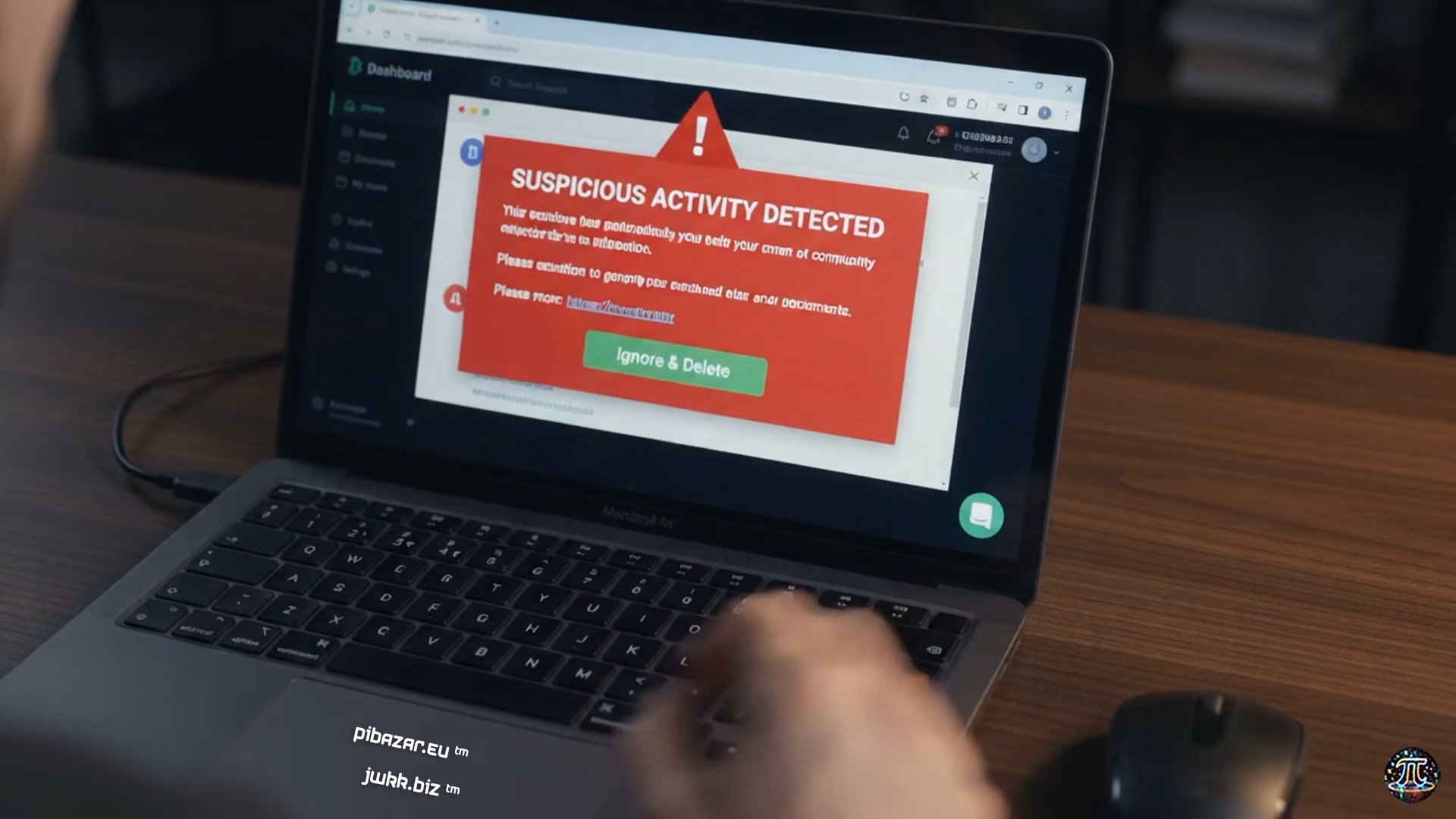
Physical Phishing and Fake Ledger The most dangerous method of 2026 is sending out physical packages. Victims of data breaches (e.g. from the previous Ledger database hack) will receive an envelope containing a “new” Ledger Nano X device. The enclosed letter, signed directly by Pascal Gauthier (Ledger CEO), urges them to replace their old device for security reasons. Inside is a modified board with a soldered flash memory containing malware. Once a user enters their seed into the fake Ledger Live app, they immediately lose their PI coins and other crypto.
Other current threats:
- TON network phishing: Scammers send fraudulent transactions with a comment containing links to fake websites immediately after a user makes a deposit.
- Fake apps: Chrome apps masquerading as wallets and scam sites like
piaccess.orgpromising to unlock locked coins sooner. - High Price Lure: Offers to buy back PI for an unrealistic $15-$50 each, which only serve to entice you to screenshot your balance and then launch a malware attack.
Golden Rule: Never enter your 24 seed words into any application on your computer, on your keyboard, or in your browser. The only safe place for the seed is a physical button on a verified hardware device.
Point #4: The Wallet Dilemma – Official Comfort vs. Cold Security
Wallet selection is critical in 2026. While some offer ecosystem dApps, others focus on pure security.
| Wallet | Best for | Type | Main benefit |
|---|---|---|---|
| Pi Network Wallet | Native ecosystem | Mobile | Direct access to Pi dApps and browser; private keys support. |
| Trust Wallet | Multi-crypto portfolio | Mobile | Manage PI alongside BTC/ETH; private key control. |
| Bitget Wallet | Active traders | Web/Exchange | Integrated swaps, DeFi tools and fast trading. |
| Ledger | Maximum security | Hardware | Requires community app / 3rd party interface; PI is not natively in Ledger Live. |
Caution: For hardware wallets, PI support remains limited and dependent on community developers. This is not a „plug-and-play“ solution like Bitcoin.
Point No. 5: Technological Leap – Subscription Smart Contracts
While the price is stagnant, the technology is advancing. In April 2026, the first subscription smart contract was activated on the testnet (under the PiRC2 framework). This allows recurring on-chain payments for services (streaming, membership) with a pre-approved budget.
At the same time, the network is going through a phase of forced upgrades. The February 2026 update pushed the protocol to version v23, which optimized node performance. Currently, the Core Team requires all Pi Node operators to upgrade to v24, which is a prerequisite for stability in the Open Mainnet.
Analysis of the Pi Network Ecosystem and Asset Security Options (May 2026)
This document provides a comprehensive overview of the current state of the Pi Network, Pi coin storage options, and critical security risks associated with this ecosystem, based on available analysis and reports from May 2026.
1. Summary
As of May 2026, Pi Network is in a crucial phase after the launch of the open mainnet (February 2025). Founded by Stanford graduates, the project has an extremely high user base (over 60 million registered users), but it also faces significant volatility and market skepticism.
Key findings:
- Market status: The price of the Pi coin is hovering around $0.18, down more than 93% from its all-time high of $2.99.
- Technological foundation: Pi is a Layer 1 blockchain using a modified Stellar Consensus Protocol (SCP) that relies on social bonds (security circles) instead of energy-intensive mining.
- Migration and adoption: Over 16 million users have successfully completed the KYC process and migrated their balances to the mainnet.
- Security warning: The ecosystem is being targeted by sophisticated phishing attacks, including fraudulent apps and fake hardware devices sent through the mail.
2. Technical architecture and vision of Pi Network
Pi Network is profiled as an accessible alternative to traditional cryptocurrencies, which allows „mining“ on smartphones without high energy consumption.
The basic pillars of the network
- Stellar Consensus Protocol (SCP): Instead of Proof-of-Work, Pi uses a trust-based algorithm. Nodes form “quorum slices” based on recommendations from other participants.
- Security Circles: Groups of 3-5 trusted individuals who confirm each other’s identities, creating a global trust graph for validating transactions.
- Network Roles:
- Pioneers: Regular users of the mobile app.
- Contributors: Users who build security circles.
- Ambassadors: Users expanding the network through a referral system.
- Nodes/SuperNodes: Users running validation software on computers.
Tokenomics
The maximum supply is set at 100 billion PI, divided 80% for the community and 20% for the founding team. Currently, only about 9 billion coins are in circulation, which poses a significant risk of future dilution (dilution) with further releases.
3. Analysis of wallets for Pi Coin
Choosing the right wallet is essential for protecting your investments. Sources identify four main options, each with a different risk and convenience profile.
Top Wallets Comparison in 2026
| Wallet | Type | Best for | Main Advantages | Disadvantages |
|---|---|---|---|---|
| Pi Network Wallet | Mobile | Native support | Integration with Pi browser, direct access to dApps. | Limited to Pi ecosystem only. |
| Trust Wallet | Mobile | Multiple currencies | Support for thousands of tokens, user-friendly interface. | More susceptible to mobile threats (hot wallet). |
| Ledger | Hardware | Long-term retention | Maximum security, offline key storage. | Higher price, less convenient for daily use payments. |
| Bitget Wallet | Web/Mobile | Active traders | Integrated swap, DeFi tools, fast exchange access. | Dependence on online device security. |
Important note about hardware wallets
Although Ledger is considered the most secure option, there have been reports in the community of compatibility issues with Ledger Live. In some cases, integration with third-party applications is required to manage Pi on a Ledger device.
4. Security Threats and Prevention
Pi Network users are under constant pressure from fraudsters in 2026. Sources cite several critical scenarios:
Identified scam tactics
- Fake buyout offers: Scammers contact users with offers to buy Pi at unrealistically high prices (e.g. $20-50 per coin) off exchanges. The goal is to lure wallet credentials.
- Ledger scam apps: There are illegitimate versions of the software (often in the Chrome Store) that require the user to enter a 24-word recovery phrase (seed).
- Physical phishing: Victims of previous data breaches have received fake Ledger Nano X hardware devices in the mail that have been modified (flash drive added) to steal private keys.
- Phishing pages in Pi Browser: Fraudulent websites like „piaccess.org“ simulate the official interface and steal balances after entering passwords.
Principles of Safe Asset Handling
- Never share your seed (passphrase): No official Pi Network representative or wallet manufacturer will ever ask for your recovery phrase.
- Use 2FA: Enable two-factor authentication (ideally via an application like Google Authenticator, not SMS).
- Verify sources: Download software only from official websites (e.g.
minepi.comorledger.com). - Check addresses: When making transactions, always check the entire address, not just the first and last characters (protection against „address poisoning“).
5. The path to mainnet and technical milestones
The project is going through an „open mainnet“ phase, which requires active user involvement in technical processes.
Migration process
In order for a user to be able to dispose of their coins, they must:
- Complete the KYC (Know Your Customer) process in Pi Browser.
- Get confirmation of balance migration from mobile app to mainnet wallet.
- As of April 2026, over 18 million KYC verified users have been confirmed.
Node Roles
Pi Network is striving for gradual decentralization through desktop nodes:
- Computer App: Basic interface for chat and balance management on a PC.
- Node: Verifies the integrity of the blockchain, but does not participate in consensus.
- SuperNode: The backbone of the network, responsible for reaching consensus and writing to the distributed ledger. Requires 24/7 operation and stable connectivity.
Current Status: Protocol upgrades to v24 are underway in May 2026. All Mainnet nodes must be updated to maintain network stability and security.
View
Pi Network remains an experimental project with a huge community but unclear long-term value. The transition to an open mainnet has enabled trading on exchanges such as MEXC, OKX or Gate.io, but the absence on the largest platforms (Binance, Coinbase) limits liquidity.
The main challenge for 2026 remains the creation of real utility (e.g. the planned Pi DEX or subscriptions via smart contracts) and managing the enormous price pressure due to the gradual release of billions of coins from locked balances. The user is advised to be extremely cautious when protecting their private keys.
Conclusion: The Future at a Crossroads
Pi Network faces its biggest test in 2026. On one side is the huge mass of 16 million migrated users, compliance with MiCA, and the fact that the Kraken exchange has included Pi Network in its roadmap for integrating new chains. On the other hand, there is a crushing price collapse and centralization that is in direct contradiction to the ideals of Web3.
Will Pi Network become the basis of a new economic ecosystem, or will it remain the largest social experiment that has paid for its lack of transparency?
Whatever your answer, remember: in crypto, you do not own the coins until you are the sole holder of your private keys. The future of Pi is uncertain, but your safety should be an absolute priority.
Share the article 🙏
Related articles …
Pi Network
Pi Network Announcement
Pi Network is a blockchain-based cryptocurrency project that aims to allow users to mine Pi coins using smartphones. The project aims to promote cryptocurrency adoption.
The project was launched by PhD students at Stanford University in 2019. Pi Network offers users a simple and environmentally friendly way to mine Pi coins by simply opening the app and pressing a button once a day.
One of the features of the Pi Network is that users can increase the mining speed by expanding their network. In addition, the Pi Network aims to increase the value of Pi coins by allowing users to create and use web applications on the Pi> platform.
Pi Network is currently launching its mainnet. To join Pi Network, you need to download the mobile app and enter an invitation code. Pi Network is an innovative project that aims to pave the way for the future of cryptocurrencies.
How to join Pi Network
If you are not a member of Pi Network, you can get started in 5 minutes by clicking this link. By registering with my referral code jwkkbiz we can both earn Pi. Pi Network is an application that allows you to easily mine the cryptocurrency „Pi“ on your smartphone. By pressing a button once a day, you start mining for 24 hours, even if you leave your phone idle. In 2024, I mined 360 days a year, and those who accepted the invitation received many benefits. If you register with the referral code jwkkbiz, you will get a 25% increase in mining speed.
After 30 mining, you will pass KYC (Know Your Credit), so don’t forget to enter your real name when registering. If you register incorrectly, you will lose 20% as a penalty.
For more detailed information and reasons for registration, see here.
Mohlo by se vám také líbit:
- Free shares worth up to €100 on Trading 212
- Pi Network a „314 159 USD hodnota“: Největší hoax v historii projektu
- Kde externě sledovat, poslouchat a číst PiBazar.eu
- Aktivita sítě Pi prudce roste, záhadná peněženka získává miliony v PI coinech
- CS GO skins
- Shrnutí Pi Network Říjen 2025 – AI, Web3 a KYC
- Pi Network Blockchain Testnet1 byl upgradován
- Pi Online – Spuštěna: Interstellar Farm Battle Royale
Zanechat odpověď