
Sdílej článek:
This article details the Pi Network ecosystem’s directory staking system, which serves as a decentralized tool for application visibility and evaluation.
Users and businesses can lock up their Pi tokens to support specific services, organically increasing their ranking in the Pi Browser and attracting more attention. This method provides developers with an efficient way to acquire new users without having to go through the complex approval processes of other platforms. Additionally, a recent visual interface refresh makes it easier to navigate and discover new projects within the growing community. Although the network does not offer direct rewards for staking, application creators can provide their own incentives and benefits for their supporters. The whole mechanism thus transforms the economic activity of the community into a transparent indicator of the quality and popularity of digital tools.
Article content 📖
Estimated reading time: 12 minut
Podcasts 🎙️ Infographics 🖼️
Podcasts
Explanation [Video]
A structured, comprehensive overview that links the individual pieces of information from the article.
Detailed Analysis [Audio]
Live conversation between two moderators, analyzing and connecting topics from the article.
Infographic
Digital Currency Ecosystem Staking Guide
![Digital Currency Ecosystem Staking Guide [Infographics]](https://pibazar.eu/wp-content/uploads/2026/08/digital-currency-ecosystem-staking-guide-infographics-scaled-png.avif "Digital Currency Ecosystem Staking Guide [Infographics]")
Turning Attention into Value: A New Era of App Discovery on the Pi Network
In today’s digital age, we face a fascinating paradox: thanks to generative AI, app creation has never been more accessible, but the path to real users has never been more thorny. In the flood of digital “noise” and thousands of new projects emerging with almost zero marginal costs, even the most brilliant ideas are often lost. The Pi Network, with a community of over 60 million engaged members, responds to this challenge with an elegant solution: the concept of “Ecosystem Directory Staking”, which transforms mere attention into measurable economic value.
Wallet Voting: What is Directory Staking?
The essence of this system is decentralized staking within the ecosystem directory. Unlike traditional Web2 platforms, where app ratings are reduced to stars or comments – which can be easily forged by an army of bots – the Pi network model introduces the concept of “economic weight”.
Pioneers and companies can stake their Pi on the Mainnet blockchain to directly influence the ranking of projects in the Pi Browser interface (PiApps section). This mechanism applies to the entire spectrum of services: from native Mainnet applications to projects from Pi App Studio to services such as centralized exchanges. The more Pi is staked on a particular service, the higher its visibility. It is a transparent, community-driven curation process where support is expressed through real investment, not just empty clicks.
Strategic tool for breaking through market noise
For developers and so-called „vibe coders“, staking is an extremely effective, lightweight tool for user acquisition. In an environment where AI enables mass-production of applications, attention becomes the most precious resource. This is where staking acts as an unquestionable “skin-in-the-game” signal – proof that the creator or community believes in the quality of the product enough to vouch for it with their own capital.
Compared to platforms like Pi Ad Network or Pi Launchpad, which require complex approval processes and administrative burdens, Directory Staking is designed as a “self-service” path. It offers creators the opportunity to immediately leverage the network’s attention with minimal setup effort, making it ideal for agile teams that need to quickly test market response and gain a critical mass of users.
Evidence instead of promises: CiDi Games‘ success as a catalyst for change
The effectiveness of this model in practice was clearly demonstrated during the beta testing of the CiDi Games application. Within less than a week of launch, community interest was so intense that the app’s ranking organically supported 3.19 million Pi stalls.
This massive signal of trust triggered an immediate chain reaction in real-world traffic: the app logged over 1.2 million play sessions in less than seven days. This success became the catalyst for the subsequent shift in the user ergonomics of the entire system.
Milestone in User Ergonomics: New Visual Interface
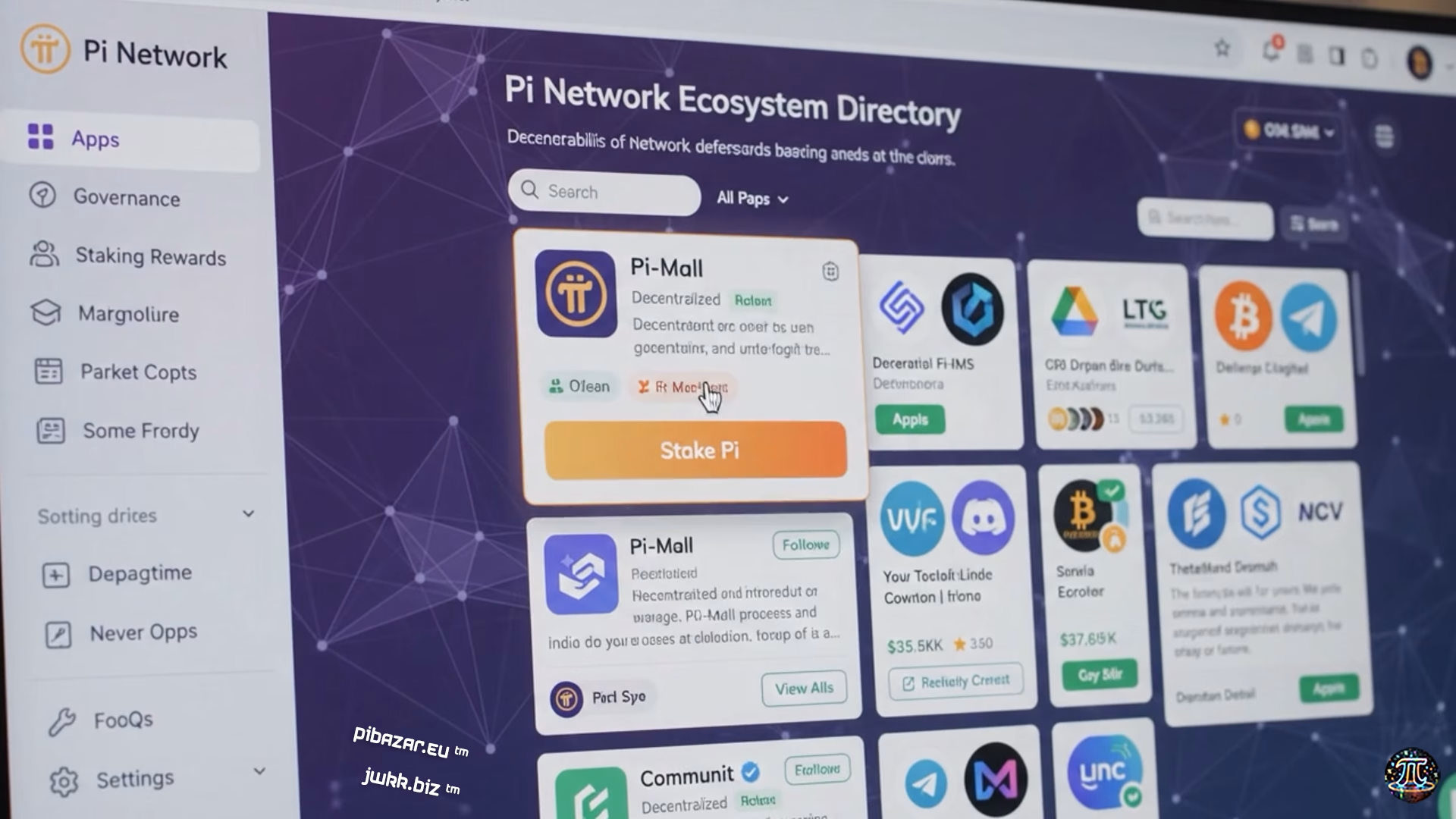
In June 2026, the system underwent a major design update that took app discovery to a new level. This update is not just an aesthetic change; it is a profound shift towards a community-driven “discovery” model. The new interface in the PiApps section now serves as a dynamic, living map of the ecosystem, allowing Pioneers and businesses to navigate more smoothly and intuitively support their favorite tools. This improved navigation makes it easier to transform collective sentiment into real-time visibility of the best projects.
Transparency and Security: Rules of the Game
To keep the system fair and sustainable, it is built on clear protocols:
- Protocol Neutrality: There are no staking rewards at the Pi network level. The network remains a neutral arbiter and does not favor anyone; The ranking is solely the result of community activity.
- Third-party incentives: It is entirely up to app developers to decide whether to reward users for their support – for example, in the form of exclusive in-app features, premium content or promotions.
- Return of deposit: A key security feature is that the original staked amount is returned to users in full after the selected staking period.
The Future of Curation in the AI Era
In an era where algorithms often decide what we see, Pi Network puts power back in the hands of the people. As the official analysis aptly states:
“Ecosystem Directory Staking can be particularly useful because AI-powered tools make it easier to build applications, but harder to reach real users.”
Staking thus becomes a democratic filter that separates the wheat from the chaff. The role of the community as a collective curator of content will only grow in the future, with the economic weight of the vote ensuring that only those projects that bring real value rise to the top.
Ecosystemic Staking Directories on the Pi Network: Comprehensive Analysis and Statistics
1. Brief Summary of Key Learnings
Ecosystem Directory Staking is a key decentralized mechanism for controlling app visibility within the Pi Browser interface. Originally launched in June 2025, the tool transforms the attention of over 60 million engaged Pioneers into a measurable on-chain signal. By replacing manipulable text reviews with a verifiable economic commitment (staking) on the Mainnet blockchain, the network creates a transparent environment for organic app promotion. The system effectively translates the „economic weight“ of the community into popularity rankings, ensuring that utilities with real user support come to the fore.
2. The essence and mechanism of Ecosystem Directory Staking
From a technical point of view, Ecosystem Directory Staking functions as a decentralized curatorial filter that replaces traditional Web2 metrics with on-chain proofs of user trust.
- On-chain staking mechanism: Pioneers and companies allocate their Pi directly on the Mainnet blockchain. This process serves as a form of “Sybil-resistance”, where visibility is conditioned by real economic cost, not just the volume of comments generated.
- Ranking Impact: Higher staked funds directly increase an app’s exposure in the ecosystem, leading to increased impressions and subsequent user traction.
- Decentralized Validation: Instead of subjective evaluation, the system uses “economic weight” to determine the relevance of apps. This is a shift from declarative interest to interest confirmed by the asset held.
- Scale of supported applications:
- Native Mainnet applications.
- Projects within Pi App Studio.
- External third-party services (e.g. centralized exchanges).
3. Strategic Benefits for Developers and Vibe Coders
In today’s environment, which is flooded with content generated by artificial intelligence (AI), staking is becoming a crucial tool for distinguishing signal from noise.
- AI Spam Filter: While AI tools dramatically facilitate the creation of applications (so-called „vibe coding“), staking acts as a filter that allows only those projects that can generate real community support to reach users.
- Minimization of Friction (Lightweight Character): Compared to tools such as Pi Ad Network or Pi Launchpad, which require demanding approval processes and administrative burdens, represents a staking platform utility with a minimal barrier to entry. This absence of approval processes is ideal for early development.
- Access to “Attention Resource”: Staking allows developers to efficiently tap into the limited attention resource of 60 million engaged users, the most valuable asset in the modern digital economy.
4. Performance Analysis: CiDi Games Case Study
The practical effectiveness of this mechanism was demonstrated during the CiDi Games beta testing, where staking served as a clear indicator of organic interest.
| Metric | Value | Timeframe |
|---|---|---|
| Total Pi Staked | 3.19 million | Less than 1 week after beta launch |
| Number of game sessions played | 1.2 million | Less than 1 week after beta launch |
| Ranking increase type | Organic | Within 1 week |
This data demonstrates that on-chain staking can generate high visibility and subsequently real utility (gaming sessions) in an extremely short time, without requiring central intervention in the ranking algorithms.
5. Design and User Experience Update (June 2026)
The week of June 18, 2026 saw a significant user interface (UX) update that further reduces the barriers to ecosystem discovery.
- PiApps Tab Modernization: A new visual design for the PiApps tab has been implemented in the Pi Browser, which simplifies the staking-based app rankings.
- UX Optimizations: The goal of the update was to simplify navigation and make it easier for Pioneers to find new utilities. This is a purely design and functional improvement of the interface, not a change in the blockchain protocol.
- Availability: The new interface is fully ready for use by developers, creators, and ordinary users, thus increasing the overall ergonomics of the ecosystem.
6. Economic Parameters and Staking Rules
The design of the staking mechanism is built on the principles of network neutrality and the security of user assets.
- Protocol Neutrality: At the protocol level, no rewards are paid in Pi. This is a deliberate decision in the network design to prevent the protocol from artificially favoring specific applications and to maintain a decentralized meritocracy.
- Third-Party Incentives: All rewards for staking users are the responsibility of the application developers. They can motivate the community through:
- In-app bonuses and premium content.
- Increased quality of services and exclusive promotions.
- Inherent economic incentives within the tokenomics of the application.
- Capital protection: After the selected staking period, the original staked amount is returned to the user in full. Staking in this context does not represent a payment, but a temporary tying up of capital as proof of support.
Question for the Community
Ecosystem Directory Staking represents an evolution in how we approach digital attention. In a network of 60 million active members, staking is becoming the most powerful voice we have. It is a tool that gives every Pioneer the opportunity to actively shape the shape and success of the entire ecosystem.
What application in the Pi ecosystem do you consider valuable enough to stake your stake for its visibility? Have your say ✏️
Share the article 🙏
Related articles …
Pi Network
Pi Network Announcement
Pi Network is a blockchain-based cryptocurrency project that aims to allow users to mine Pi coins using smartphones. The project aims to promote cryptocurrency adoption.
The project was launched by PhD students at Stanford University in 2019. Pi Network offers users a simple and environmentally friendly way to mine Pi coins by simply opening the app and pressing a button once a day.
One of the features of the Pi Network is that users can increase the mining speed by expanding their network. In addition, the Pi Network aims to increase the value of Pi coins by allowing users to create and use web applications on the Pi> platform.
Pi Network is currently launching its mainnet. To join Pi Network, you need to download the mobile app and enter an invitation code. Pi Network is an innovative project that aims to pave the way for the future of cryptocurrencies.
How to join Pi Network
If you are not a member of Pi Network, you can get started in 5 minutes by clicking this link. By registering with my referral code jwkkbiz we can both earn Pi. Pi Network is an application that allows you to easily mine the cryptocurrency „Pi“ on your smartphone. By pressing a button once a day, you start mining for 24 hours, even if you leave your phone idle. In 2024, I mined 360 days a year, and those who accepted the invitation received many benefits. If you register with the referral code jwkkbiz, you will get a 25% increase in mining speed.
After 30 mining, you will pass KYC (Know Your Credit), so don’t forget to enter your real name when registering. If you register incorrectly, you will lose 20% as a penalty.
For more detailed information and reasons for registration, see here.
Mohlo by se vám také líbit:
- Free shares worth up to €100 on Trading 212
- Aktualizace Podcastů – Rozdělení [CZ] a [EN] verzí
- Pi Network a „314 159 USD hodnota“: Největší hoax v historii projektu
- Kde externě sledovat, poslouchat a číst PiBazar.eu
- Kryptopád Listopadu 2025: Proč Pi Network klesá a co čekat dál
- Mince Pi Network na týdenním [32] grafu drží pevně
- Pi Network Hackathon 2025: Přehlídka Midpoint a Nový Hackathon Ecosystem Tab a Staking
- Co je to likvidita?
- Co je to ledger ? – Účetní kniha
Zanechat odpověď