
Sdílej článek:
Introductory Summary
This article analyzes the Pi Network’s initiative to leverage its global infrastructure of nodes for decentralized artificial intelligence (AI) training and computing tasks. The main finding is that the Pi Network has significant unused computing capacity that can be transformed into a decentralized cloud. A successful pilot project with OpenMind has demonstrated that distributed Pi nodes can efficiently perform image recognition tasks for robotic systems. With a combination of over 421,000 nodes and tens of millions of KYC participants, Pi Network is shaping up to be a unique infrastructure capable of addressing the limits of centralized computing and offering „human-in-the-loop“ services for AI learning.
Article content 📖
Estimated reading time: 12 minut
Podcasts 🎙️ Infographics 🖼️
Podcasts
Explanation [Video]
A structured, comprehensive overview that connects individual pieces of information from the article.
Detailed analysis [Audio]
A live conversation between two moderators, analyzing and connecting topics from the article.
Infographic
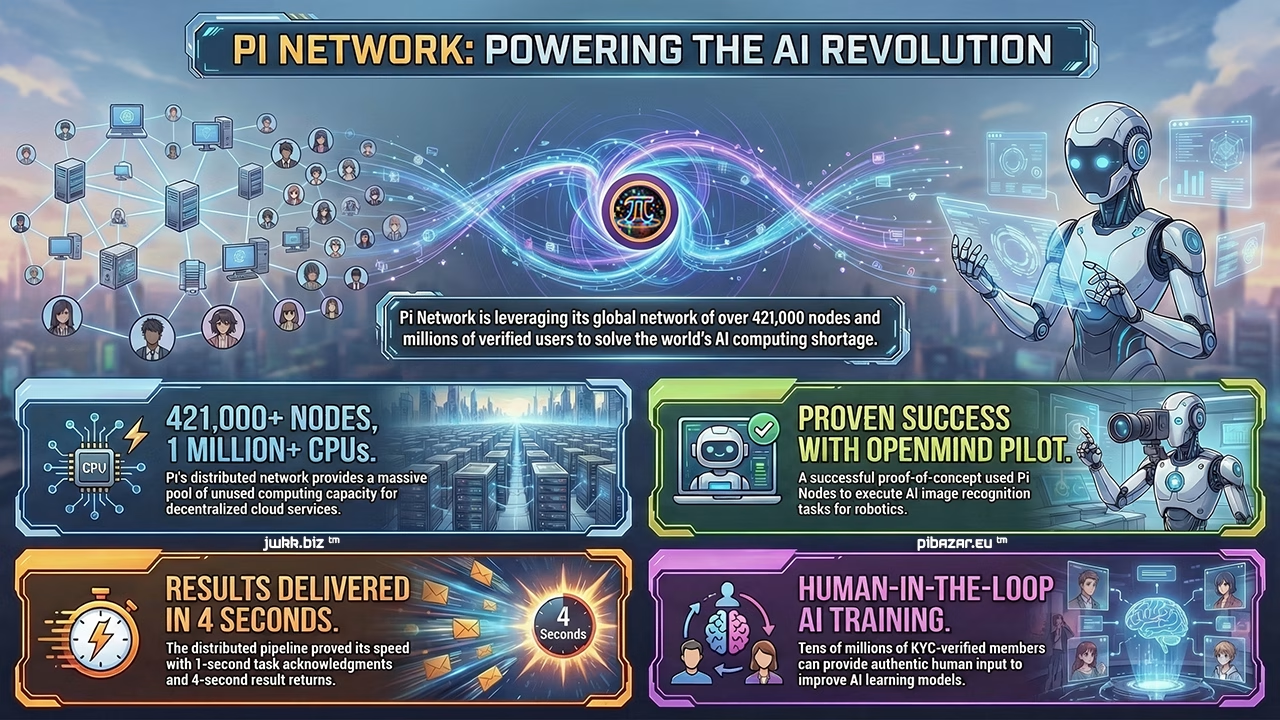
The Decentralized AI Frontier [Infographic]
![The Decentralized AI Frontier [Infographic]](https://pibazar.eu/wp-content/uploads/2026/03/the-decentralized-ai-frontier-infographic-png.avif "The Decentralized AI Frontier [Infographic]")
Pi Network: Decentralized AI Computing and the OpenMind Case Study
The Pi Network project is exploring new ways to leverage its global infrastructure to address high-demand computing power for artificial intelligence. Through a large network of decentralized Nodes, the platform aims to offer unused processor capacity for model training and cloud services. A recent collaboration with robotics company OpenMind has successfully demonstrated in practice that user volunteers can effectively handle complex tasks such as image recognition. In addition to pure performance, the system also benefits from millions of verified participants who can provide the necessary human feedback for learning algorithms. The entire initiative aims to create an alternative to traditional data centers, with node operators receiving rewards in cryptocurrency for their help. This strategy connects blockchain technology with the real economy and democratizes access to the production of artificial intelligence.
Your computer as a brain for robots?
The current boom in artificial intelligence (AI) is running into an inexorable physical reality: an insatiable hunger for computing power. The traditional model of centralized data centers is beginning to show critical cracks – from extreme energy demands to the logistical limits of infrastructure expansion. At this tipping point, however, a digital giant is awakening, which many have only seen through the lens of mobile cryptocurrency. Pi Network, with its global infrastructure, in collaboration with the OpenMind initiative, is opening the way to a new era where hundreds of thousands of home computers become the distributed brains for future generations of robots.
Unused supercomputer in your living room
While tech giants invest billions in building energy-intensive server farms, Pi Network has access to a colossal power that already exists but has so far been idle. The global network currently has over 421,000 active nodes, which together represent more than 1 million CPUs. This decentralized cloud does not require the construction of new buildings or additional load on transmission systems; it uses hardware that people already own and that is not used to its full potential most of the day.
From the perspective of an innovation specialist, this is a brilliant use of existing resources. Node operators can voluntarily provide their free power for demanding calculations and receive a reward in cryptocurrency, thus turning passive hardware into an active economic tool.
The Pi network blockchain is designed with an emphasis on energy efficiency. It does not require the full computing resources of such a large network to secure its distributed ledger. This creates a unique space for new utilities, such as decentralized cloud computing, where operators can provide their free performance to third parties for demanding tasks such as inference or training AI models.
„One-stop service“: When CPU meets human judgment
Pi Network brings to the world of AI an element that centralized providers like AWS or Google Cloud cannot offer in this form: tens of millions of KYC verified identities. For AI developers, this represents a so-called „one-stop service“. Within a single transaction layer, they gain not only raw computing power (CPU), but also access to authentic human feedback (Human-in-the-loop).
In practice, this means that a developer can run model inference on the network while using authenticated users to correct and label data in real time. This synergy of authentic human input and distributed power is key to eliminating errors and ethically tuning AI, making Pi Network a unique infrastructure for developing safe and accurate intelligence.
OpenMind Case Study: Triumph of Distributed Latency
Proof that this is not a futuristic vision is the successful proof-of-concept implemented with the OpenMind platform. OpenMind is not only developing an operating system for robots, but above all an open-source protocol that allows machines to learn and collaborate. To test the capabilities of Pi Network, OpenMind developed a special container (PaaS approach) that volunteer node operators ran on their machines.
The pilot project focused on visual inference – the ability of AI to recognize objects in an image, a critical skill for robot navigation. The results yielded crucial technical data:
- Participants: The test was successfully conducted on 7 selected node operators.
- Acknowledgement Latency: Tasks sent via distributed broadcast received acknowledgement from all workers within 1 second.
- Inference Speed: Image recognition results were delivered back within 4 seconds.
- Validity and reliability: The AI model correctly identified objects as „bus“ or „person“. The experiment confirmed not only the successful broadcast of tasks, but above all the return-path reliability of the results to the client.
The response speed in the order of seconds for a decentralized system is a breakthrough that proves that the Pi Network is ready for real deployment in tasks requiring high dynamics.
Overcoming limits: Antidote to „catastrophic forgetting“
Centralized AI systems encounter a phenomenon known as such as “global-state bottlenecks” and the risk of “catastrophic forgetting.” This occurs when models trained in isolated large ensembles struggle to accommodate new data, inadvertently overwriting and losing previously acquired skills.
The decentralized architecture of the Pi Network naturally circumvents these barriers. Instead of concentrating power and data in a single point, the distributed nature of the network allows it to maintain a much more diverse and resilient “global state.” By computing and learning across hundreds of thousands of endpoints, the network avoids the energy concentration and physical limits of data centers, offering startups and corporations a sustainable alternative for scaling their AI models.
OpenMind Case Study: Decentralized Computing Systems on the Pi Network
Context and Strategic Intent
Pi Network extends the functionality of its nodes beyond just securing the blockchain. Because the Pi network blockchain is energy efficient, it does not require the full computing resources of its vast network. This creates space for new utilities:
- Decentralized cloud computing: Leveraging unused capacity for third parties requiring performance to train AI models.
- Economic model: Node operators who volunteer to participate earn cryptocurrency rewards from clients using their resources.
- Utility integration: This initiative complements the Pi app ecosystem, platform utilities, and local commerce.
Analysis of Market Challenges in the AI Era
Pi Network research identifies two critical problems that a decentralized approach helps solve:
- Limitations of Centralized Computing:
- Capacity Limits of Data Centers center.
- High concentration of energy consumption.
- Structural problems such as „catastrophic forgetting“ or global-state bottlenecks.
- Growing demand for computing power:
- With the development of AI agents and models, society needs unprecedented amounts of power.
- It is necessary to mobilize and coordinate fragmented, yet unused resources using distributed technologies.
Pi Network’s Unique Position
Pi Network has specific assets that differentiate it from other computing service providers:
- Infrastructure Scale: The network includes over 421,000 nodes, representing more than 1 million processor cores (CPUs).
- Know-Your-Customer (KYC) Community: Tens of millions of participants with verified identities can provide authentic human feedback („human-in-the-loop“) for AI learning processes.
- Comprehensive Service: Combining raw computing power with human input offers AI clients a comprehensive one-stop solution.
Case Study: Cooperation with OpenMind
In October of last year, a Proof-of-Concept (PoC) project was completed with OpenMind, a company developing an open operating system for robotics.
Testing methodology
OpenMind developed a software container capable of demanding computational tasks. This container was distributed to volunteer Pi node operators. The task was to process images using an object recognition model, which is key for OpenMind robots to interact with the real world. The goal was to identify as many discrete objects as possible in the provided data.
Key results and metrics of the pilot project
| Metric | Value / Result |
|---|---|
| Number of participants | 7 volunteer Pi node operators |
| Confirmation speed tasks | Within 1 second of submission (all 7 workers) |
| Result return speed | Within 4 seconds (inferential results from multiple nodes) |
| Data quality | Correct object detection (e.g. bus, person) including bounding boxes |
| Path reliability | Confirmed functionality of distributed broadcast and return path of results |
The pilot project confirmed that Pi nodes can perform AI-relevant workloads and quickly return valid results to external clients, independent of their blockchain responsibilities.
Future Directions and Research
While distributed AI training is still in the research phase globally, Pi Network plans to continue with the following activities:
- Alternative Infrastructure: Offering solutions for AI startups looking for alternatives to centralized systems.
- Intersection of Blockchain and AI: Developing infrastructure that supports fair participation and distribution in within the future economy.
- Scaling: Further exploring the possibilities of how to efficiently package computing capacity with authentic human input.
This approach aims to fulfill the vision where the decentralized infrastructure of the Pi network forms an integral part of the global economy and allows individuals to directly participate in the processes of artificial intelligence production for appropriate compensation.
Conclusion and Future Outlook
Pi The network is transforming from a mere cryptocurrency to a vital infrastructure for a fairer digital economy. By connecting idle hardware with proven human intelligence, an ecosystem is created where the community benefits from the development of AI, not just a narrow circle of server farm owners. Although fully distributed AI training is still in the early stages of research globally, the results with the OpenMind protocol clearly show that decentralized intelligence is no longer a utopia, but a technical reality.
Final thought
Are we ready for a world where AI is not trained by corporations behind closed doors, but by all of us together on our own devices?
Share the article 🙏
Related articles …
Pi Network
Pi Network Announcement
Pi Network is a blockchain-based cryptocurrency project that aims to allow users to mine Pi coins using smartphones. The project aims to promote cryptocurrency adoption.
The project was launched by PhD students at Stanford University in 2019. Pi Network offers users a simple and environmentally friendly way to mine Pi coins by simply opening the app and pressing a button once a day.
One of the features of the Pi Network is that users can increase the mining speed by expanding their network. In addition, the Pi Network aims to increase the value of Pi coins by allowing users to create and use web applications on the Pi> platform.
Pi Network is currently launching its mainnet. To join Pi Network, you need to download the mobile app and enter an invitation code. Pi Network is an innovative project that aims to pave the way for the future of cryptocurrencies.
How to join Pi Network
If you are not a member of Pi Network, you can get started in 5 minutes by clicking this link. By signing up with my referral code jwkkbiz, we can both earn Pi. Pi Network is an application that allows you to easily mine the cryptocurrency „Pi“ on your smartphone. By pressing a button once a day, you start mining for 24 hours, even if you leave your phone idle. In 2024, I mined 360 days a year, and those who accepted the invitation received many benefits. If you register using the referral code jwkkbiz, you will get a 25% increase in mining speed.
After 30 mines, you will pass KYC (Know Your Credit), so don’t forget to enter your real name when registering. If you register incorrectly, you will lose 20% as a penalty.
For more detailed information and reasons for registration, see here.
Mohlo by se vám také líbit:
- Aktualizace Podcastů – Rozdělení [CZ] a [EN] verzí
- Pi Network a „314 159 USD hodnota“: Největší hoax v historii projektu
- Kde externě sledovat, poslouchat a číst PiBazar.eu
- Pi Network Milestone Celebrations and Token Ecosystem Development
- Co je Soroban? Jak souvisí s Pinet.com ?
- Co je Pi Laboratoř ?
- Predikce ceny mince Pi, protože divergence otevřeného zájmu naznačuje zotavení – co nás čeká, 0,5 nebo 0,32 USD?
- Vítěz hackathonu Pi Network naznačuje vstup na Coinbase uprostřed přechodu Pi na open source
Zanechat odpověď